
A repair-shop surfer shows how to choose a surfboard that helps you stand up faster, survives baggage handlers, and won’t break the bank.
Your first surfboard is like your first musical instrument. The right one feels natural in your hands, helps you progress faster, and keeps you excited to learn. The wrong board, even if it looks cool, can kill your enthusiasm and make every session feel like a struggle. And even if a board performs well on the wave, there are hidden pitfalls you won’t see at first glance.
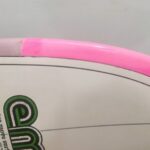
A friend of mine recently bought a beautiful, brightly painted board. It looked perfect in photos. But after her very first wipeout—a small crack on the nose appeared. That’s when we discovered the manufacturer had used a thick layer of acrylic paint. To properly repair the color, we would have had to repaint the entire board. What should have been a quick fix turned into a costly, complicated project—all because of a small detail the shop never mentioned.
In this article, I’ll show you how to choose your first surfboard—one that will actually help you learn, survive your first few trips, and won’t let you down when you travel. Here’s what we’ll cover:
- The exact volume and length you’ll need for your body and goals
- Which materials are easy to repair—and which are headaches
- How to avoid common mistakes when buying in a shop
- What types of boards are best for flying or road trips
- And why most beginners regret their first board (and how to avoid that)
Everything here comes straight from real-life experience—repair shop lessons, surf school feedback, other beginners’ stories, and my own mistakes. No fluff, no marketing myths. Just the practical advice that will actually save you money, time, and stress.
Picking your first board? Consider trying different options before you buy—check out our local surfboard rental in Da Nang.
Beginner Surfboard Size Table

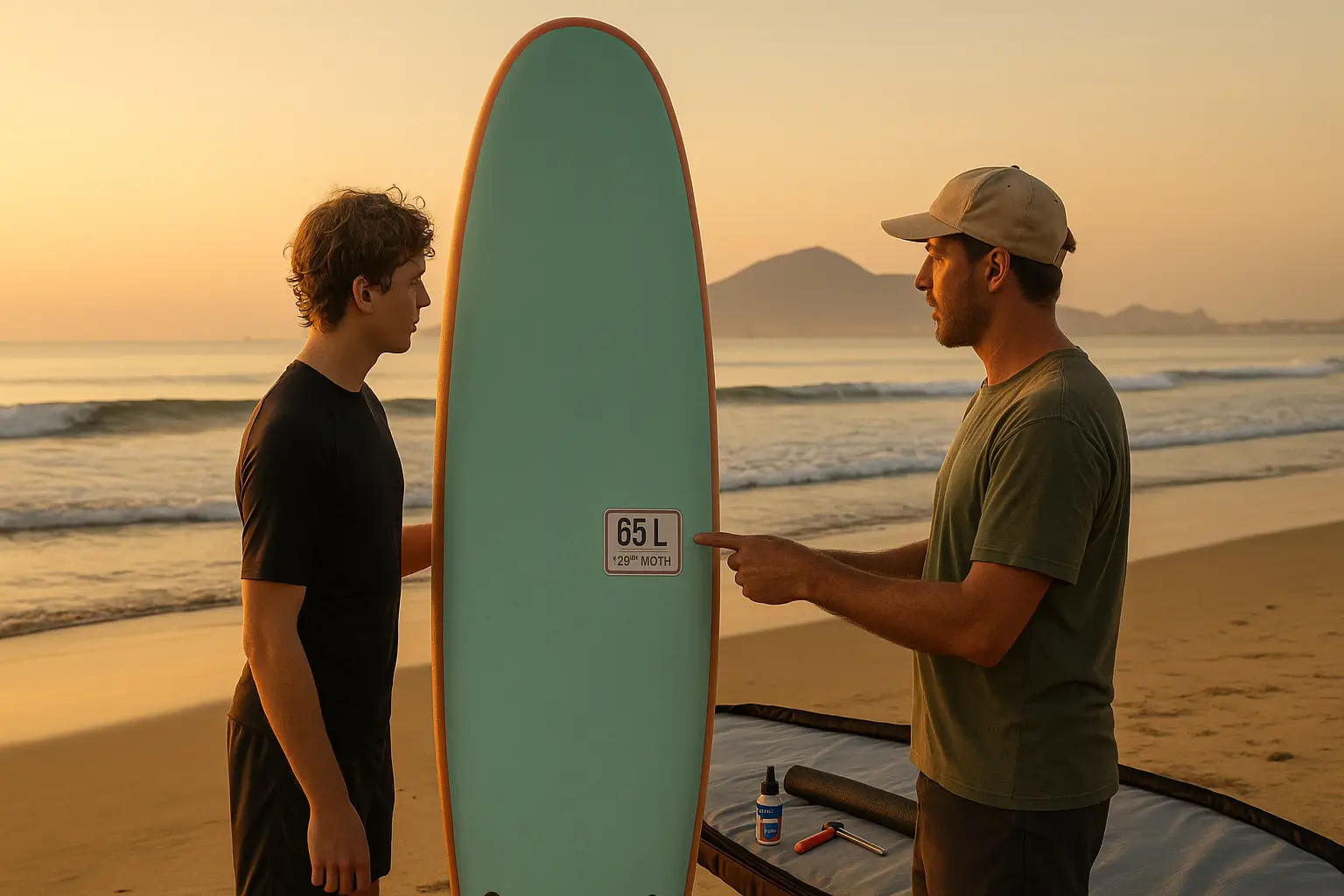
Getting the right size surfboard is key if you want to actually learn, not just struggle. Just find your weight and use these numbers when you shop.
| Weight (kg) | Volume (L) | Length (ft) | Min width (in) | Typical thickness (in) | Best type |
|---|---|---|---|---|---|
| 45–55 | 45–55 | 7’6”–8’0” | ≥22.5″ | 2 ⅞–3 ⅛ | Soft-top mini-mal |
| 55–70 | 55–65 | 8’0”–8’6” | ≥22.75″ | 3–3 ¼ | Soft-top longboard |
| 70–85 | 60–75 | 8’6”–9’0” | ≥23.0″ | 3 ⅛–3 ⅜ | Soft-top longboard |
| 85–100 | 70–85 | 9’0”–9’2” | ≥23.25″ | 3 ¼–3 ½ | Soft-top longboard |
| 100–115 | 80–95 | 9’2”–9’4” | ≥23.5″ | 3 ⅜–3 ⅝ | Soft-top longboard |
| 115+ | 95–110+ | 9’4”+ | ≥23.75″ | 3 ½–3 ¾ | Soft-top longboard |
Notes (keep with the table):
- Width and thickness are stability cues; hit the volume first, then choose the nearest length/width.
- Thickness ranges assume typical epoxy/PU shapes; soft-tops often don’t list thickness—use volume + width as your primary selectors.
- Heavier wetsuits or weak summer waves → lean to the upper end of the volume/length range.
Examples:
- Weigh 70 kg? Look for something around 8’0”, 55–65 liters, wide and thick.
- 85 kg? Go for 8’6”–9’0”, 65–75 liters.
- Over 90 kg? Don’t be shy—look for a 9’0”+ board, 75+ liters.
Small boards look cool, but if you’re a beginner, they’ll just slow you down. A longer, higher-volume board will let you catch more waves and stand up without fighting the board the whole time.
Don’t try to “tough it out” on a small board. Every surf school recommends more volume at the start. You’ll have more fun, more progress, and less frustration. Trust the numbers.
Need extra guidance? Check our complete guide to beginner surfing in Vietnam.
Board Anatomy 101: What Makes a Board Easy to Ride
If you want a board that helps you learn, pay attention to these parts:
- Nose (front)
Wide and round is best. It gives you balance, helps you catch weak waves, and doesn’t “dive” under water as much. Think of it like a wide ski—harder to tip over. - Rails (sides)
Soft, rounded rails are your friends. If the rails are too sharp, the board catches the water and you wipe out more. Rounded rails let the board forgive your mistakes. Imagine the difference between the edge of a butter knife and the edge of a sword. - Tail (back end)
Go for a big, wide tail. Square or rounded shapes work best. They keep the board stable and make it easier to stand up. Pointy tails are for pros, not for learning. - Fins (bottom, near the tail)
Three fins (“thruster” setup) is the gold standard. It’s stable and lets you turn easily enough without feeling too loose or too stiff. - Rocker (the curve from tip to tail)
Look at your board from the side. If it’s almost flat (little curve), that’s good for learning. Flat boards paddle faster and glide longer. Boards with a big curve (more “rocker”) are harder to paddle and not for beginners. - Outline (shape from above)
Wider boards are always easier to stand on and less “tippy”. Think of a wide raft vs. a narrow canoe. - Volume (how much the board floats)
More volume = easier paddling, better balance. You want a board that feels like it floats with you, not just under you. If you’re not sure, ask for a surfboard volume calculator at the shop—just give your weight.
A big, wide, thick board with soft rails, a rounded nose, and a flat bottom will help you catch more waves and learn way faster. Sharp, skinny, or curvy boards are for later
Don’t get talked into something fancy. The best beginner boards look simple, even boring. But you’ll stand up sooner, and that’s what counts.
How Beginners Really Progress: From Foamie to Your First “Real” Board
Every surfer wants to skip the “beginner stage” and jump straight onto something short and cool-looking. But trust me—going too small, too soon is the fastest way to get stuck. You’ll enjoy surfing (and improve way faster) if you move through these simple steps:
| Stage | Best Board | Why It Works | When to Upgrade |
|---|---|---|---|
| First 0–30 sessions | 8–9’ Foamie (Soft Top) | Easy to balance, catch waves, and survive wipeouts. | When you can paddle, catch, and stand almost every time |
| 30–100 sessions | 7’0–7’6” Funboard/Mini Mal | More maneuverable but still forgiving. | When pop-ups and turns feel natural |
| Travel/Next level | 6’10” Travel Hybrid (Epoxy) | Compact for travel, tougher, can handle most waves. | When you need to pack light or want more challenge |
Story Time: The Instagram Disaster
A guy named Matt on Reddit’s r/BeginnerSurfers once posted about his “perfect” first board—a tiny, hard-top shortboard with flames on it. He lasted two sessions before giving up:
“Every wave just rolled under me. I thought I sucked at surfing. Then I rented a big foamie and actually stood up for the first time. Night and day difference.”
He later joked, “If you want to quit surfing, buy the smallest, coolest-looking board you can find.”
Why Soft Tops Work Best First
Those big, soft foam boards are like training wheels. You might feel silly carrying it, but you’ll catch five times more waves, wipe out less, and actually start to have fun.
I’ve seen people stubbornly stick with “hard-top” boards early on, spending half their session swimming after their board. The ones who swallow their pride and start with a foamie always improve faster—and have way fewer bruises.
Upgrade Only When It’s Easy
Don’t rush. Switch boards when your current one feels boring and easy, not because someone tells you to. If you’re standing up every time and ready to turn more, then move to a funboard or mini mal.
If you travel a lot, look into a strong epoxy travel board, or even one that breaks into pieces for flights.
TL;DR:
- Start big, soft, and stable.
- Move down in size only when you’re really ready.
- Ignore what “looks cool.” Go with what lets you actually surf.
Respect your own learning curve and you’ll love surfing a lot more.
Curious which surf spots match your skill level? Explore our detailed guide to the best Da Nang surf spots.
Durability vs. Repairability: What You Trade
When choosing your first surfboard, two words matter most: durability and repairability. A durable board saves you from constant repairs, surviving bumps from baggage handlers, accidental drops, and beginner wipeouts. Repairability means quick, easy, and inexpensive fixes when things inevitably go wrong.
Epoxy boards hit a sweet spot between toughness and convenience. They’re strong enough to handle rough treatment, like falling off your scooter or rough airline handling. When something does break, small dings and cracks can be fixed at the beach in 15 minutes using a simple UV-resin kit. This makes epoxy boards perfect for beginners who travel often or surf rocky breaks.
Soft-top boards (foamies) are virtually bulletproof. You could accidentally drop one from your roof rack or bang it into rocks, and it’ll probably be fine. That toughness gives peace of mind—perfect when you’re learning and don’t want to worry about every bump or scratch. The downside is aesthetic: once punctured, foamies look messy when repaired. The fix itself is easy (hot glue and tape), but these boards quickly show their age, making resale tough. Still, for pure ease and worry-free learning, soft-tops are hard to beat.
PU boards (classic fiberglass) deliver that traditional, flexible surfing feel that experienced surfers love—but there’s a trade-off. They’re the easiest to damage, prone to dents and cracks, and more likely to soak up water. Repairs typically require professional attention, meaning more time out of the water and more money spent. If you’re a beginner still learning to handle your board carefully, PU isn’t your best choice.
Quick recommendations:
- Epoxy: Best all-around choice for beginners and travelers. Easy DIY fixes, minimal hassle.
- Soft-top: Ideal if you want maximum durability and minimal worry, but accept they’ll look worn quickly.
- PU: Choose only once you’re consistently catching waves and treating your board carefully—more rewarding feel, but higher risk and cost of damage.
Small accidents are inevitable, so keep a UV resin kit and repair tape in your board bag—this small habit can save entire surf trips. And remember, all boards hate sun and heat: always store them shaded or ventilated.
Choosing wisely now means less stress, fewer repairs, and more fun catching waves.
Durability & Materials: What Actually Lasts (and How to Fix It)
If you’re a beginner, your board will get dings, bumps, and maybe a few cracks. What matters most is how tough it is—and how easy (or hard) it is to fix. Here’s what people who fix boards every week really see:
What Material Should You Pick?
Epoxy > Soft-top > PU (polyurethane)
- Epoxy:
The toughest choice for new surfers. Takes knocks, travel, and mistakes better than anything. A small crack? You can fix most dings in 15 minutes with a UV-cure kit like Solarez Epoxy UV Cure—squeeze it in, put it in the sun, done. Most rental boards and modern travel boards are epoxy for a reason. - Soft-top:
Almost unbreakable for beginners. You can drop it, knock it into rocks, stand on it on the beach—usually no problem. If you punch a hole through the soft outer layer, it’s still fixable: clean it up, use a hot glue gun and strong tape or a softboard repair kit. There are people who’ve surfed entire seasons with duct tape and hot glue repairs. - PU (classic fiberglass):
These feel great but break the easiest. One hit against rocks or airport luggage belts, and you’re looking at a real repair. Not the best choice for learning or frequent flyers.
Most Common Repairs (From Real Shops):
- Nose and rail dings:
Happens when you fall or hit the sand. Epoxy survives these the best; PU cracks easily. - Fin box damage:
Classic after a rough airline trip. Epoxy can usually be patched; PU is more work. - Deck pressure dents:
From knees and elbows. Soft-tops barely dent, PU decks can look battered fast. - Punctures in soft-top skins:
Fix with a hot glue gun and tape or a soft-top patch kit. Field repairs that last. - Delamination (bubbles under the glass):
Happens most on old PU boards left in the sun. Epoxy and soft-tops handle heat better.
How to Fix It Yourself
- Epoxy boards: Rinse, dry, add UV-cure epoxy (like Solarez or Phix Doctor), and leave it in the sun for 10–15 minutes.
- Soft-tops: Hot glue gun is a real hack. Melt glue into any hole, smooth it out, and cover with Gorilla Tape or a patch. Will last all summer if you do it right. Example: One surfer on Swaylocks wrote, “Three seasons on a soft-top, fixed with hot glue and duct tape. Never leaked, never stopped surfing.”
- PU boards: Needs special PU resin, patience, and a place to let it cure. Not a quick fix.
Repair Shop Advice
- If you’re not sure about materials, start with epoxy or a tough soft-top. They survive almost anything and save you money on repairs.
- Small dings aren’t the end of the world—most can be fixed in under 30 minutes, even at the beach.
- For trips, always pack a repair kit: UV-cure glue, tape, and a fin key.
Travel Checklist: Flying With Your Surfboard—No Drama
Airline Limits at a Glance
(Always confirm before you book—rules change without warning.)
| Airline | Max Length | Max Weight | Quick Note |
|---|---|---|---|
| Air New Zealand | 6’5” / 198 cm | 23 kg | Under 6’5” counts as a regular checked bag |
| VietJet | 9’0” / 274 cm | 32 kg | Book “sports equipment” when you buy ticket |
| Vietnam Airlines | 7’5” / 230 cm | 23 kg | Longer boards need prior approval + fee |
| Singapore Air | 6’6” / 200 cm | 32 kg | Often free if within bag allowance |
| Qatar Airways | 9’0” / 274 cm | 32 kg | Up to 9 ft usually accepted as checked bag |
How to Keep Your Surfboard Safe When Flying
Protect the rails with cheap pipe foam—costs nothing, saves your board from cracks. Wrap the nose and tail in bubble wrap or towels. Take all fins off and pack them separately. Double-bag if you can: day-bag inside a coffin bag works like armor. Tighten straps so nothing moves.
Don’t forget:
Fin key. Lose it, and you’re stuck watching from the beach.
Duct tape or ding tape for emergency fixes.
Board bag with wheels—your back will thank you.
Spare leash and warm-water wax—hard to find abroad.
Most airline dings are smashed noses—pipe foam stops 90% of them (ask any Da Nang coach).
Always call the airline and get the agent’s name—rules change on a whim in Asia.
Keep a mini repair kit in your board bag: UV glue, sandpaper, tape. Repairs on the beach beat searching for a shop.
Pick a board that fits airline rules and pack it tough. Better to look paranoid than to lose a session to a stupid crack.
Budget & Lifetime Costs
Don’t look only at the sticker price. Think in season terms: the board itself, a bag and leash, a couple of small fixes, and—at the end—what you can sell it for.
Cheapest way to start: a used soft-top 8–9 ft, usually $200–350. You’re surfing right away and not stressing about scratches. You’ll resell it for less after a season, but it buys you a lot of practice.
A bit more serious, lasts longer: a used epoxy funboard 7’–7’6″, often $350–600. Tough, and small dings are a 10–15 minute UV-resin job—then back in the water. This is the most common “can’t go wrong” pick for beginners.
Want it new: a new epoxy, $600–900. Higher upfront, but clean history and usually easier to resell later.
Extras: a simple day bag, leash, and a small repair kit add roughly $120–200. Flights may charge $100–300 round trip for a board. A fin-box repair at a shop is about $60–120.
If you expect to surf 20–30 times this season, buying usually beats renting—and you progress faster on the same board every session. At season’s end, a well-kept epoxy typically resells better than a soft-top. Simple rule: the fewer “adventures” your board has, the more money you get back.
Spot-Specific Tips: Da Nang & Warm-Water Waves
Why extra volume works here
Da Nang is mostly beachbreak with soft, peaky wind-swell. Sets don’t always have a lot of push, so boards with more volume and width catch waves earlier and keep speed through flat sections. As a rule, add +5–10 L to whatever your size table suggests for cleaner paddle-outs and easier takeoffs, especially in summer.
Quick picks for Da Nang
- < 70 kg: 8’ soft-top (55–65 L) or 7’6” funboard for clean mornings.
- 70–90 kg: 8’6” (65–75 L); step to a 9’ on smaller days.
- 90 kg+: 9’+ (75–90 L), wide outline, soft rails.
Daily rhythm & tides
- Mornings are friendliest: lighter wind, tidier sandbars, less crowd.
- Mid to high tide tends to be kinder to beginners; low tide can turn dumpy and fast.
- Afternoons are often onshore—fine for foamies, harder on small hard-tops.
Heat care for boards
Warm water and hot sand mean heat stress for boards. Keep them out of direct sun, crack the bag zip for airflow, and avoid leaving your board in a closed car. For wax, use tropical/hard (warm-water) wax; lay a light base coat once, then refresh a thin top layer.
Fins, leash, and setup for softer waves
Run a thruster with medium (or large if you’re heavier) side fins to help with drive. If the board feels sticky in small surf, slide the center fin forward a touch. Leash length ≈ board length; 7 mm cords survive beachbreak tumbles better.
Bring vs. buy vs. rent in Da Nang
- Short trip (≤2 weeks): rent. You can swap sizes for the day’s conditions and skip airline stress.
- 1 month+: buy a used epoxy or a good soft-top, then resell before you leave. You’ll progress faster on the same board.
- Flying in with a board: keep it under airline length limits, pad rails with pipe foam, and carry a small UV-repair kit.
Quick rental/used-board check
Sight down the rails and nose for cracks, squeeze around the fin boxes for movement, and look for bubbles (delamination) on the deck. A tiny ding is fine if you can seal it with UV resin; soft-top punctures are okay if they don’t flex or sponge water.
Local habits that help
Share the peak, don’t throw the board in whitewater, and give swimmers a wide berth near the flags. Rinse your gear with fresh water after each session; it keeps leashes and fin screws from corroding.
If you want, I can adapt this block with local rental names/price bands and a “buy-and-resell in Da Nang” mini-guide.
Top Beginner Mistakes — clear and varied
- Too small.
Hard to catch anything. Use the size chart; in Da Nang add +5–10 L for softer waves. - Length over volume/width.
An 8′ narrow stick wobbles. Aim for the right liters first, then ≥22.5″ width. - Skipping the foamie.
Progress stalls. Start on an 8–9′ soft-top and downsize when pop-ups feel easy. - Airline surprises.
Fees or refusals at the counter. Check length limits, book as sports gear, remove fins, pad rails. - Leash issues.
No leash or a stretched one = swims and hazards. Match length to your board; ~7 mm cord; replace when nicked. - Heat damage.
Sun blisters and soft spots kill resale. Keep it shaded, crack the bag for airflow, never in a hot car. - Buying the paint job.
Thick acrylic chips, color repairs get pricey. Judge construction and shape over artwork. - Flying with fins installed.
Cracked fin boxes are common. Fins out, screws in a pouch, nothing loose inside the bag. - No dry inspection on used gear.
Waterlogged foam hides in plain sight. Check rails, nose, around fin boxes; look for deck bubbles; odd heaviness = water. - Zero repair kit.
Tiny ding, lost session. Carry UV resin, ding tape, a bit of sandpaper, and a fin key. - Wrong wax.
Slips on takeoff. Use tropical (hard) wax here: light base once, thin refresh before sessions.
FAQ
Should my surfboard be my height?
No. Size it by volume and width, not rider height. Beginners do best with 45–95 L depending on weight and conditions. In softer waves (like Da Nang), add +5–10 L. Aim for ≥22.5″ width for stability.
How many liters do I need as a beginner?
As a quick guide: 45–60 kg → 45–55 L, 60–75 kg → 55–65 L, 75–90 kg → 60–75 L, 90 kg+ → 75–95 L. Heavier wetsuits or weaker surf? Go to the upper end.
Soft-top or hard board for my first surfboard?
Soft-top is the easiest start: safe, stable, nearly bomb-proof. If you want a hard board, choose epoxy—it’s tougher and easy to fix with UV resin. PU feels great but dings and waterlogs faster.
What length is best for learning?
Most learners do well on 8’–9′. Length helps paddling, but volume and width matter more. Look for ≥22.5″ wide and roughly 3″+ thick (or just match the liter range above).
What surfboard can I fly with?
Airline limits vary. Keep the board within common length caps, remove fins, pad the rails, and book it as sports gear. Always check your airline’s current rules before buying tickets.
When should I drop to a smaller board?
When you’re catching most waves, popping up cleanly, trimming/turning with control—and your current board feels easy. For many, that’s somewhere after 30–100 sessions.
Epoxy vs PU for beginners—what’s better?
Epoxy: tougher, lighter, quick DIY repairs—best starter choice.
PU: classic feel but more fragile and slower to fix. Save PU for later, when you’re gentle with gear.
How to Choose a Surfboard: Final Takeaways
Your first surfboard sets the tone for your entire surfing journey. Choosing wisely means less struggle, fewer costly repairs, and way more waves and smiles.
To quickly recap the magic formula:
- Volume first: More volume means more fun—especially in mellow spots like Da Nang.
- Shape matters: Wide, stable, and forgiving is always the best start.
- Material choice: Soft-top for pure ease, epoxy for durability and easy fixes, PU when you’re ready for the next level.
- Travel smart: Check airline rules, remove your fins, pack carefully, and always carry a small repair kit.
Still unsure what to pick? No worries—just leave your height, weight, and surfing plans in the comments. I’ll happily recommend a perfect board match for your goals.
If you’re visiting Da Nang, consider dropping by our local surf rental page to test-drive a board before you buy, or swing by our friendly repair shop for advice or a quick fix.
And if you found this helpful, hop onto our newsletter—no spam, just practical tips, local wave reports, and friendly surfer stories straight to your inbox.
See you out in the water soon! 🌊🤙