

Buying a used surfboard in Da Nang may seem like a smart idea. A new board is a completely different budget, while a second-hand one looks like a chance to get into surfing quickly without spending too much. And if you are still weighing whether to buy, rent, or fix what you already have, our guide to surfboard rental and repair in Da Nang and the rest of the articles on SlicedWaves can help.
But in reality, it is not that simple.
In listing photos, a board may look perfectly fine. In person, it may turn out to have been repainted, heavily worn, waterlogged, or repaired in a way that was carefully disguised as “nothing serious.” And if you do not yet have an experienced eye, it can be hard to spot that at first glance.
First, about prices in Da Nang
If you look at the used board market in Da Nang realistically, there is one thing to accept right away: prices here are often inflated.
It is not because every board is somehow special. The market is simply small, competition is limited, and the selection is not as wide as in more developed surf destinations. Because of that, what would be considered just an ordinary old board somewhere else may be sold here for noticeably more, simply because there are not many alternatives.
In this sense, people often compare Da Nang to Bali with some frustration. Bali has a more active market, more boards, a wider choice, and generally better prices. Sometimes the difference is so noticeable that people actually bring boards from there and still come out ahead.
That does not mean you cannot find a good used surfboard in Da Nang. You can. But here it is especially important not to rely only on the seller’s words and not to buy the first board that seems “pretty decent” for money that could have gotten you something better.
Speaking very roughly, a budget of up to 10 million VND can already be reasonable for a used board — but only if its condition is actually decent and the shape suits your level and weight.
Because the price alone guarantees nothing.
The most unpleasant issue: delamination

Some types of damage look scary but can actually be repaired quite well. And then there are issues that may be almost invisible from the outside, yet are exactly what can make a purchase a bad one.
One of those problems is delamination.
Put simply, this is when the outer layer of the board — the fiberglass and lamination — starts separating from the foam inside. In other words, the structure is no longer holding together the way it should, and the board gradually loses its integrity.
For someone without experience, delamination is not always easy to spot with the eyes. But it can often be felt with your hands.
Gently, without pressing too hard, push with your palm or fingers on different areas of the board, especially closer to the tail and in zones that may already have taken a lot of stress. If the surface feels too soft, caves in strangely, feels hollow, or as if there is space between the outer shell and the foam inside, that is a bad sign.
These are exactly the kinds of problems people often do not notice right away. Sometimes someone buys a board, surfs it, everything seems fine at first, and only later it turns out that part of the tail had already started separating long ago and the issue was there from the beginning.
If the board feels “softer than it should,” it is better not to convince yourself that it is a minor detail.
Repaint and cosmetic cover-ups: not always a dealbreaker, but always a reason to be cautious
A used board does not have to look perfect. Minor signs of life are normal. Especially in a place like Da Nang, where boards live under the sun, get carried on bikes, fall, get repaired, surfed again, and repaired again.
But there is one thing worth checking especially carefully: whether someone is trying to make something serious look harmless.
What should raise suspicion is not stickers, stripes, or repainted areas in themselves, but why they are there. Sometimes it is just cosmetic. But sometimes it is a way to hide an old break, a sloppy repair, color differences after restoration, or signs of serious structural work.
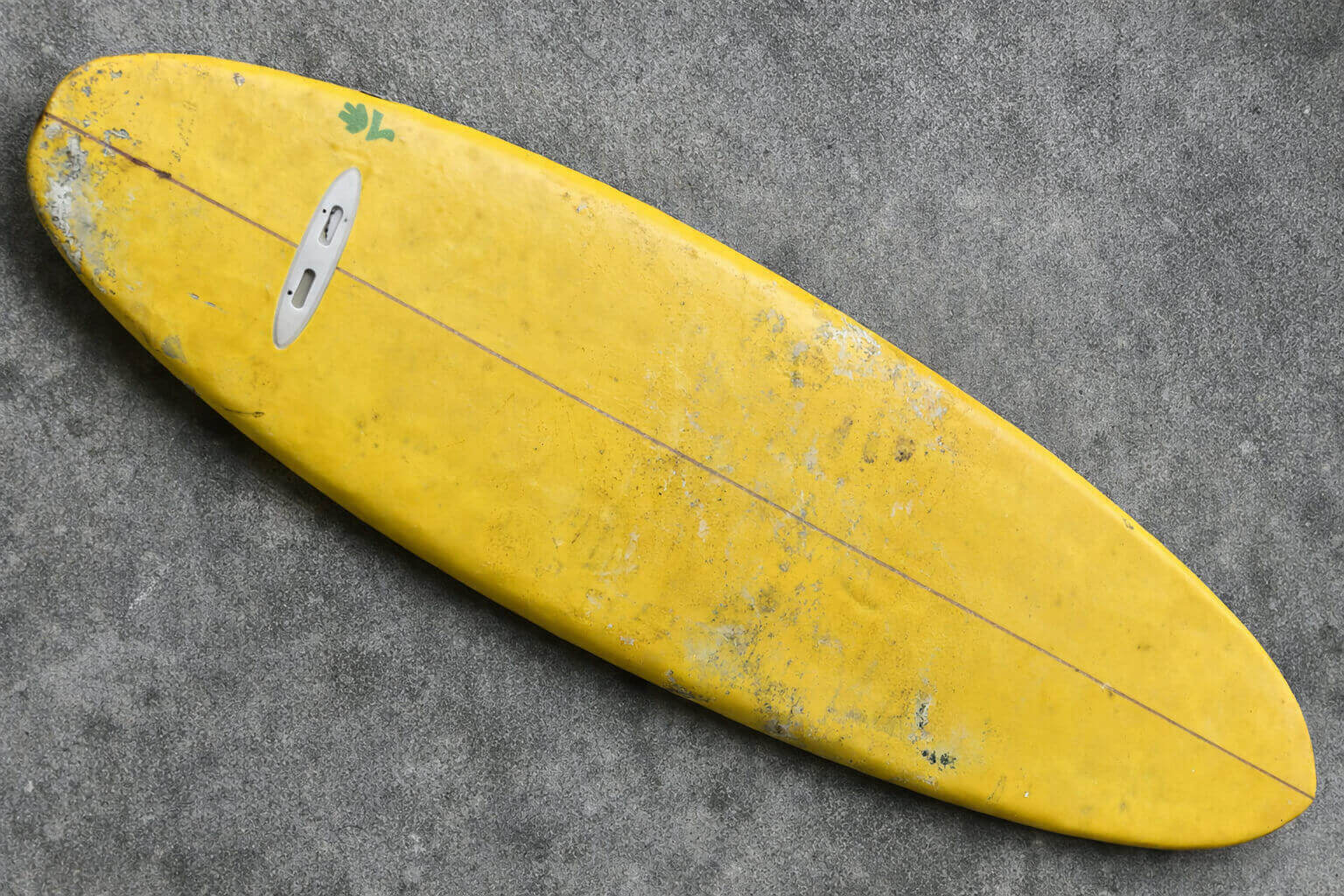
For example, if the board has clearly been repainted — especially more than once — that is already a reason to pause and ask more questions. The same goes for strange decorative elements in places where you would normally expect to see the plain surface of the board.
Sometimes a new coat of paint hides the board’s old story: the original factory logo under the glass, repair marks, a broken area, or something that simply could not be color-matched neatly.
A repaint does not automatically mean the board is bad. But if the repaint comes with a vague story, odd answers from the seller, and the feeling that something is being left unsaid, it is better to trust that feeling.
Check the fin box area separately

If a board has already been through hard impacts, transport damage, or unlucky meetings with the bottom, the area around the fin boxes is often one of the first places to reveal it.
This part takes a lot of stress, and if a fin was ever ripped out or the board hit hard on the tail, traces usually remain. Sometimes they are visible immediately, and sometimes only if you look closely.
What can be concerning:
- a different shade of material around the fin box;
- an uneven surface;
- visible signs of repair;
- cracks;
- the sense that this area has already been “worked on.”
The issue is not that the fin box was repaired at all. That happens. The real question is how well it was repaired.
A good repair is one thing.
A badly restored fin box area is a risk that you will end up dealing with the same problem again later.
If you see that the tail has had major repair work, it is better to stop looking at the board as just “a board with a few signs of use” and start seeing it as something that has already gone through a fairly serious episode in its past.
Dings are not the worst thing

This is an important point, because beginners often worry about the wrong things.
Small dings, local repairs, and old point damage do not automatically make a board bad. If everything has been sealed properly, does not leak, crumble, or fall apart, then those things can simply be part of the normal life of a used surfboard.
So not every repaired board is automatically a bad purchase.
Sometimes people see a small repair and panic straight away, when in fact it is much riskier to buy a board that looks “clean” on the outside but has soft foam, hidden delamination, or an old break covered up under repaint.
That is why you should look not at the mere fact of repair, but at its scale and quality.
A small, neat ding repair is normal.
A serious structural history is a completely different conversation.
The most important thing is not the condition — it is whether the board suits you
This is probably the main point of the whole article.
You can get so focused on finding a “healthy” board without serious damage that you end up buying something that simply does not suit you. And that is a much more common and much more frustrating mistake than, say, some old neat ding.
Because even a perfectly intact board will not help if it is:
- too small for your weight;
- too aggressive for your level;
- too performance-oriented in shape;
- simply wrong for your waves and your style of surfing.
For most people who are just starting out or still do not feel confident, it is far more important to find a board that genuinely makes it easier to catch waves, stand up, and progress than a board that looks good, “like real surfers ride,” but in practice only makes everything harder.
That is exactly why, when buying a used board, you should assess not only the damage, but also:
- your weight;
- your level;
- how consistently you already surf;
- the conditions you are most likely to surf in;
- whether you need a more forgiving board or already want something more maneuverable.
Sometimes a slightly tired but well-chosen board will give someone far more value than a beautiful, shiny, but too-small shortboard that they will simply struggle on.
What to ask the seller
When you inspect a board, it is important not only to feel it with your hands, but also to listen to how the person talks about it.
A normal seller will usually calmly explain:
- what has been repaired;
- whether the board was ever broken;
- whether there were any issues with the fin boxes;
- how old the board is;
- how often it was surfed;
- why they are selling it in the first place.
If the answers are vague, evasive, or overly reassuring — along the lines of “there’s really nothing there” — while you can already see signs of work with your own eyes, that is a reason to stay alert.
Sometimes you do not even need to catch the person in contradictions — it is enough to notice that the story sounds too smooth for a board that has clearly been through a lot.
The more honestly the seller talks about repairs, the more likely it is that you are dealing with a fair sale rather than someone trying to get rid of a problem quickly.
When it is better to just walk away
Sometimes the best purchase is not buying at all.
It is better to walk away if:
- the surface feels noticeably soft;
- you can feel signs of delamination;
- the board looks repainted without a clear explanation;
- there is a sense of an old break;
- the tail or fin boxes raise doubts;
- the seller avoids answering questions;
- the price does not match the condition.
This is especially important in Da Nang, where the choice is not endless and it is easy to talk yourself into a compromise just because “well, what else is there to find?” But a bad board will not become a good one simply because there are not many other options.
Sometimes it is better to rent a board for a few sessions , work out which size and volume suit you, and wait for a better option than to buy a board that will start causing problems very soon.
But it is not all bad. When buying a used board, you do not need to be a shaper or a repair specialist to choose a good surfboard. It is enough to know where to look, where to press, and what questions to ask.
In this article, you will learn what is worth checking before buying a used surfboard in Da Nang, especially if you do not want to overpay and then end up spending even more on repairs.
We also have another article about choosing a surfboard in Vietnam — feel free to check that one out too 🙂